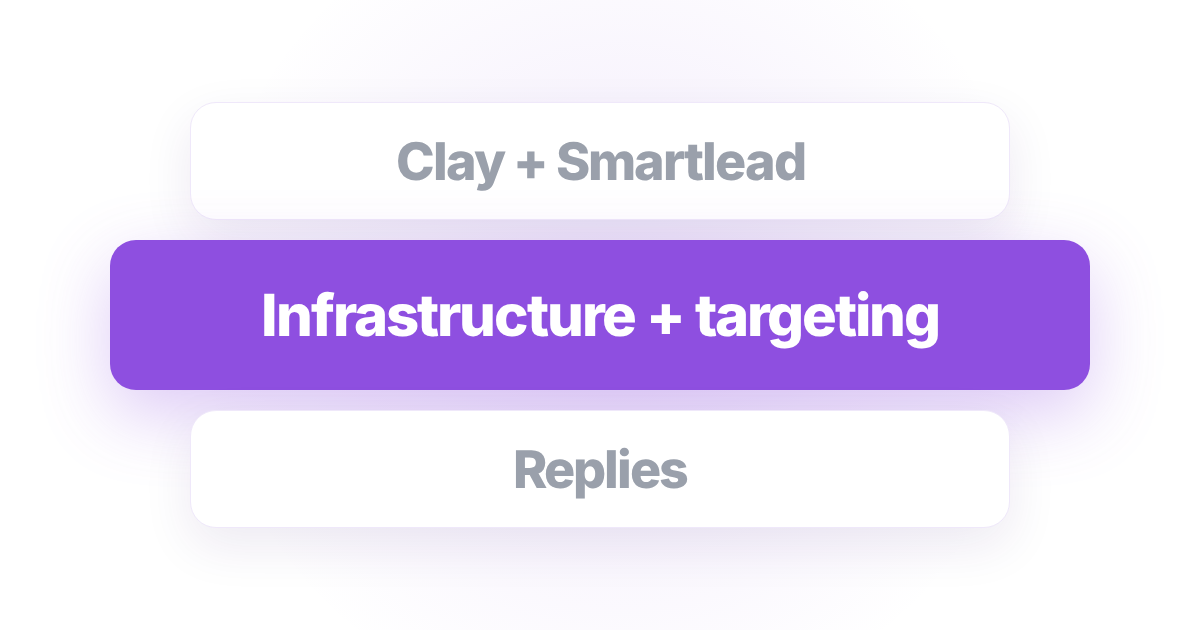
Smartlead confirmed a deeper integration with Clay shortly after Clay's $7.1B valuation raise, and the outbound corner of LinkedIn treated it as a landmark.
Vaibhav Namburi summed up the mood: best data orchestrator meets best sequencer.
It is genuinely useful. It also changes less about winning replies than the reposts suggest.
We run campaigns for clients every day, and the two things that decide whether those campaigns work sit either side of that pipeline. Underneath it, the infrastructure.
On top of it, the judgment about who to contact.
What the integration actually solves
Clay answers who to contact and what you know about them. Smartlead answers how the message goes out and from where.
The seam between those two has always been manual. CSV exports, webhook glue, a Zap that breaks when a column moves. Closing that seam is real time saved every week.
It is also now table stakes.
Any team with a budget can wire enrichment to sending in an afternoon, which means it stops being an advantage the moment everyone has it.
The part no integration does for you
Sending infrastructure decays. Quietly, continuously, and regardless of which logo sits in the middle of your stack.
One client's fleet runs about 40 domains and 176 mailboxes across Google Workspace and Microsoft 365.
It has held a deliverability health score of 93 out of 100 for a year. That number is not a feature of any tool.
It is the result of someone checking it every week.
The reverse is just as ordinary.
We have picked up sending domains that had degraded to 68, with mail landing in spam, and the fix was replacing them with fresh domains that scored 98 and 100.
No sequencer prevents that decay, and no enrichment tool tells you it is happening.
The discipline underneath is boring. Fifteen new prospects a day per mailbox. About three weeks of warmup before a new domain sends anything cold.
Break either and the best data in the world lands in a spam folder.
Cheaper enrichment makes personalization worse
Here is the uncomfortable side effect. When enrichment gets cheap and instant, everyone sends the same clever line.
In our recent campaigns, lighter personalization with tighter targeting has outperformed heavy AI personalization.
Prospects recognise a machine-written compliment on sight, and the second one they get that week is worse than no personalization at all.
The variable that still moves reply rates is who is on the list, not how many enriched fields you managed to stuff into the first sentence.
If you run outbound on your own
Pick a sequencer that fits how you work and stop reading comparison threads. Clay integrates with several of them, so the integration is not a reason to migrate anything.
We use QuickMail as the orchestrator and route sending through each mailbox's own Google or Microsoft API, so the sending tool never sits in the client's SPF record.
That decision matters more to deliverability than the choice of tool itself.
Spend the time you would have spent evaluating tools on two things instead: is this account actually a fit, and is the mailbox sending it healthy this week.
That is what our outbound orchestration work is built around, because it is where the results move.
The Questions We Get Asked
Should I switch to Smartlead because of the Clay integration?
Not on its own. Clay connects to multiple sequencers, and switching tools does not fix a deliverability or targeting problem.
Switch when your current tool blocks something you need, not when a partnership is announced.
What does Clay's $7.1B valuation mean for outbound costs?
It signals more money flowing into enrichment tooling and more competition between data providers.
It does not change what you pay to run healthy sending infrastructure, which is where most of the real cost sits.
How do I tell whether my problem is data or infrastructure?
If open rates are healthy but meetings are not landing, the list and the targeting are the problem.
If open rates are low, it is almost always domains and mailboxes, and no amount of enrichment will rescue it.