
What most people get wrong about AI in 2026.
You open Claude, type a question, get an answer. Maybe you copy-paste it somewhere. Maybe you don't.
That's how most people use AI in 2026. And honestly, that's like buying a Swiss Army knife and only using the toothpick.
We've spent the last few months going deeper - not just chatting with Claude, but learning how the tool works under the hood.
Right now Claude is the tool everyone's talking about - that may change, it may not. Most AI assistants are converging on similar capabilities. But Claude is what we know, so that's what we're building on.
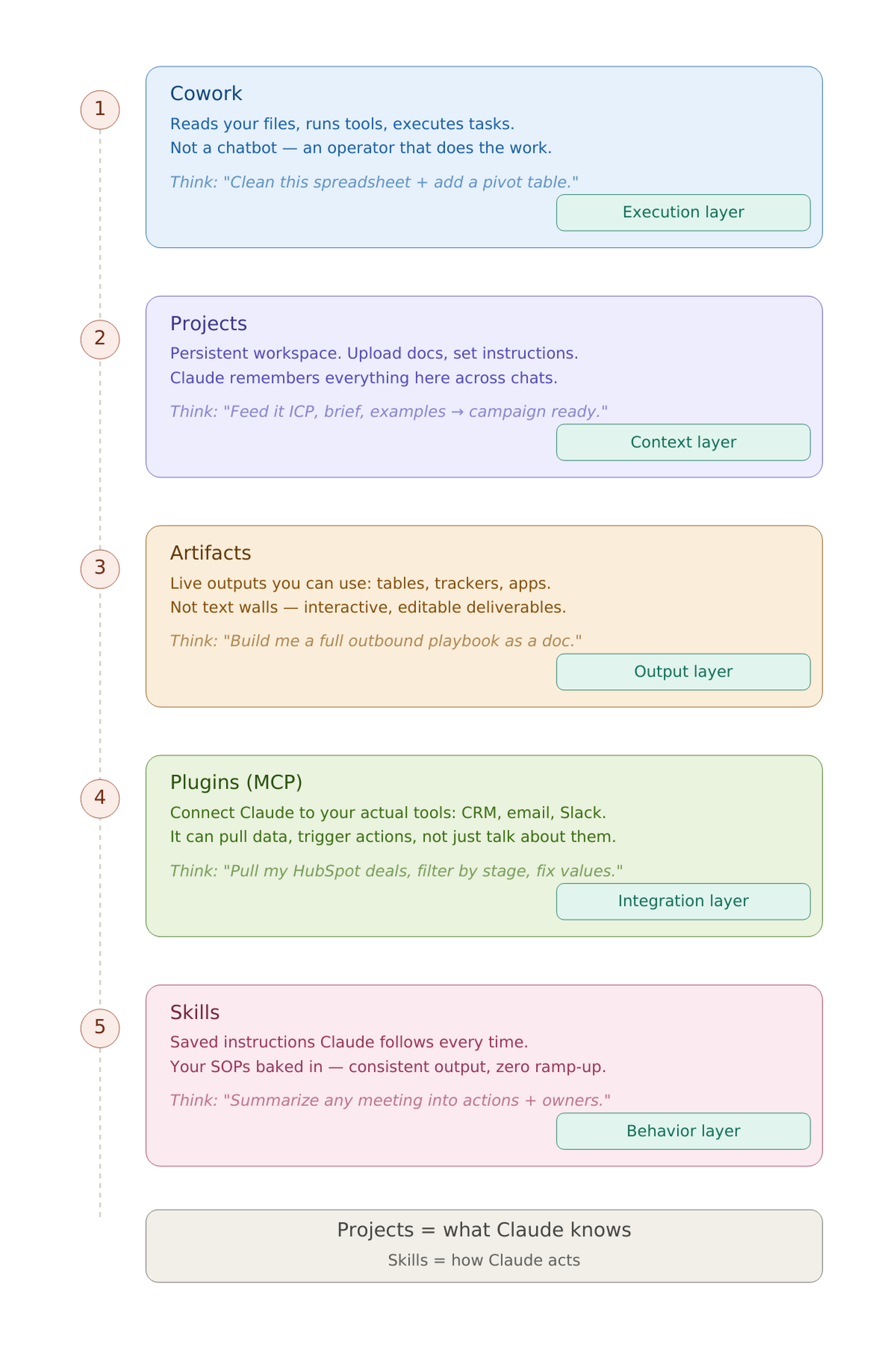
1. Cowork - the execution layer.
This is where most people stop, but even here, they're underusing it.
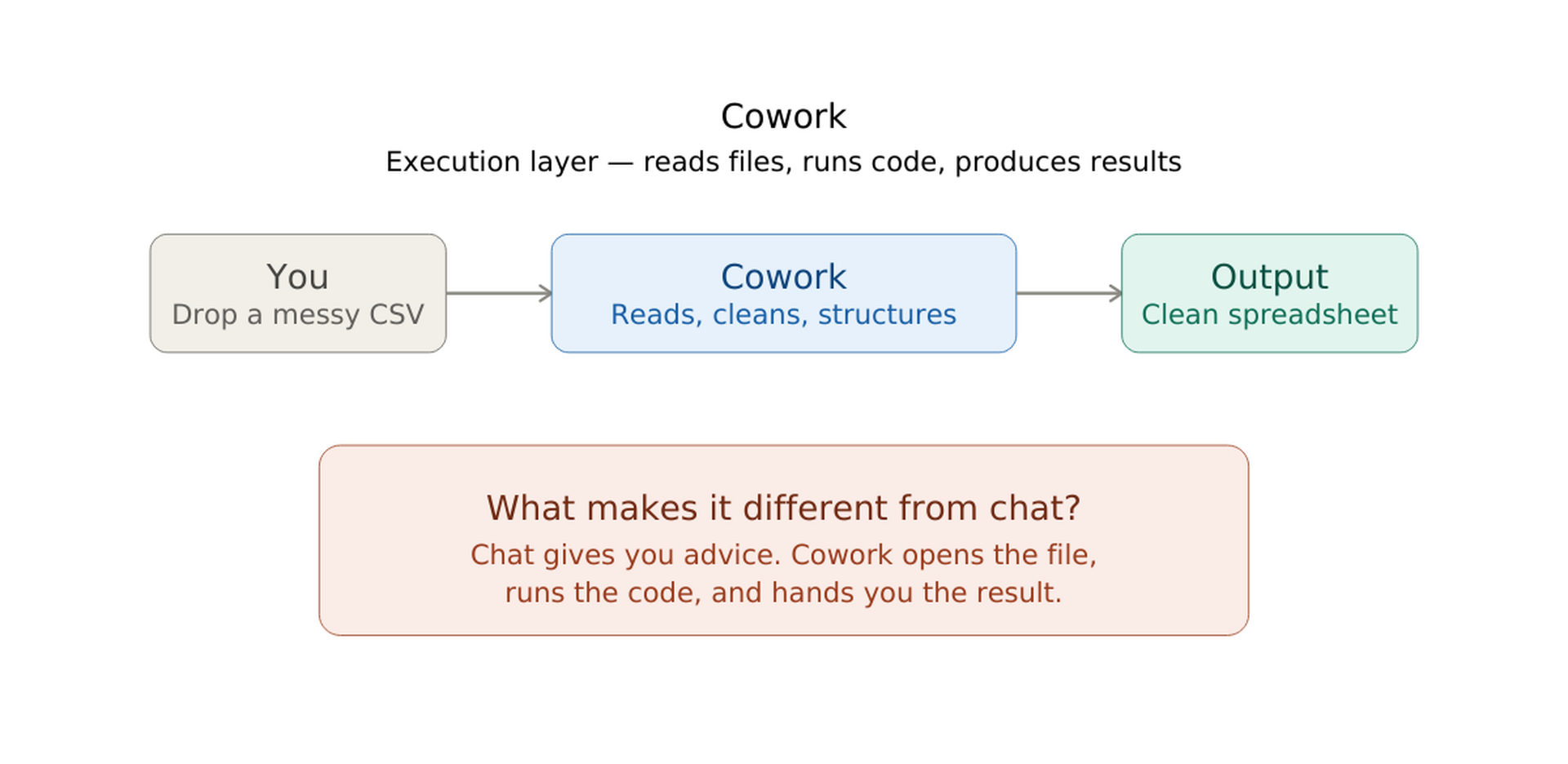
Cowork doesn't just answer questions. It reads your files, runs code, and produces the results.
You drop a messy CSV, and it cleans it, restructures it, adds a pivot table, and hands you back a finished spreadsheet.
No copy-pasting. No "here's how you could do it." It does it.
The difference between chat and Cowork is simple: chat gives you advice, Cowork does the work.
2. Projects - the context layer.
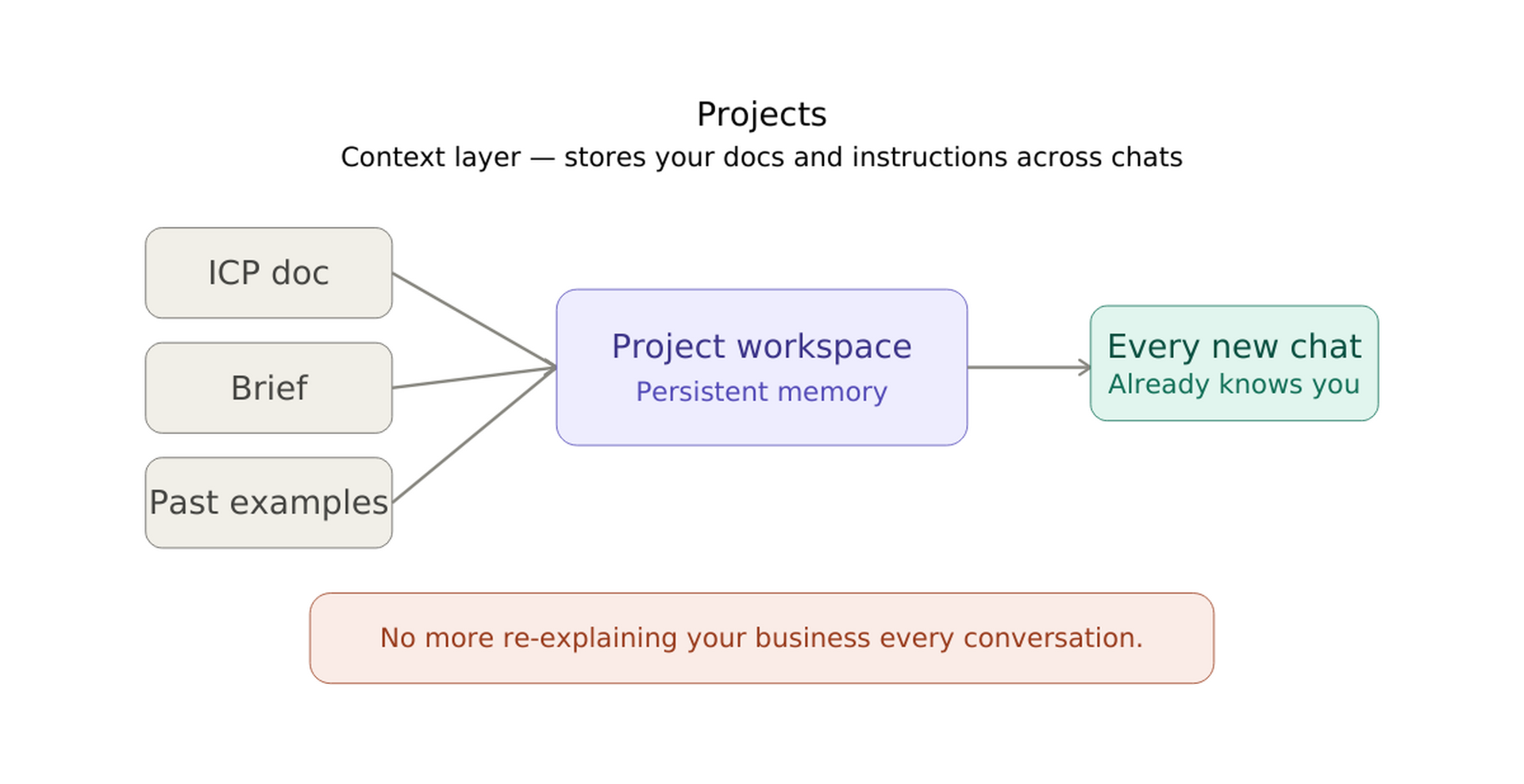
A Project is a persistent workspace where you upload your documents, set instructions, and give Claude the context it needs to actually understand your business.
Your ICP document, your brand brief, examples of past work - all of it lives there.
Every new chat inside that Project starts where the last one left off. Claude already knows your audience, your tone, your constraints. You don't re-explain anything.
3. Artifacts - the output layer.
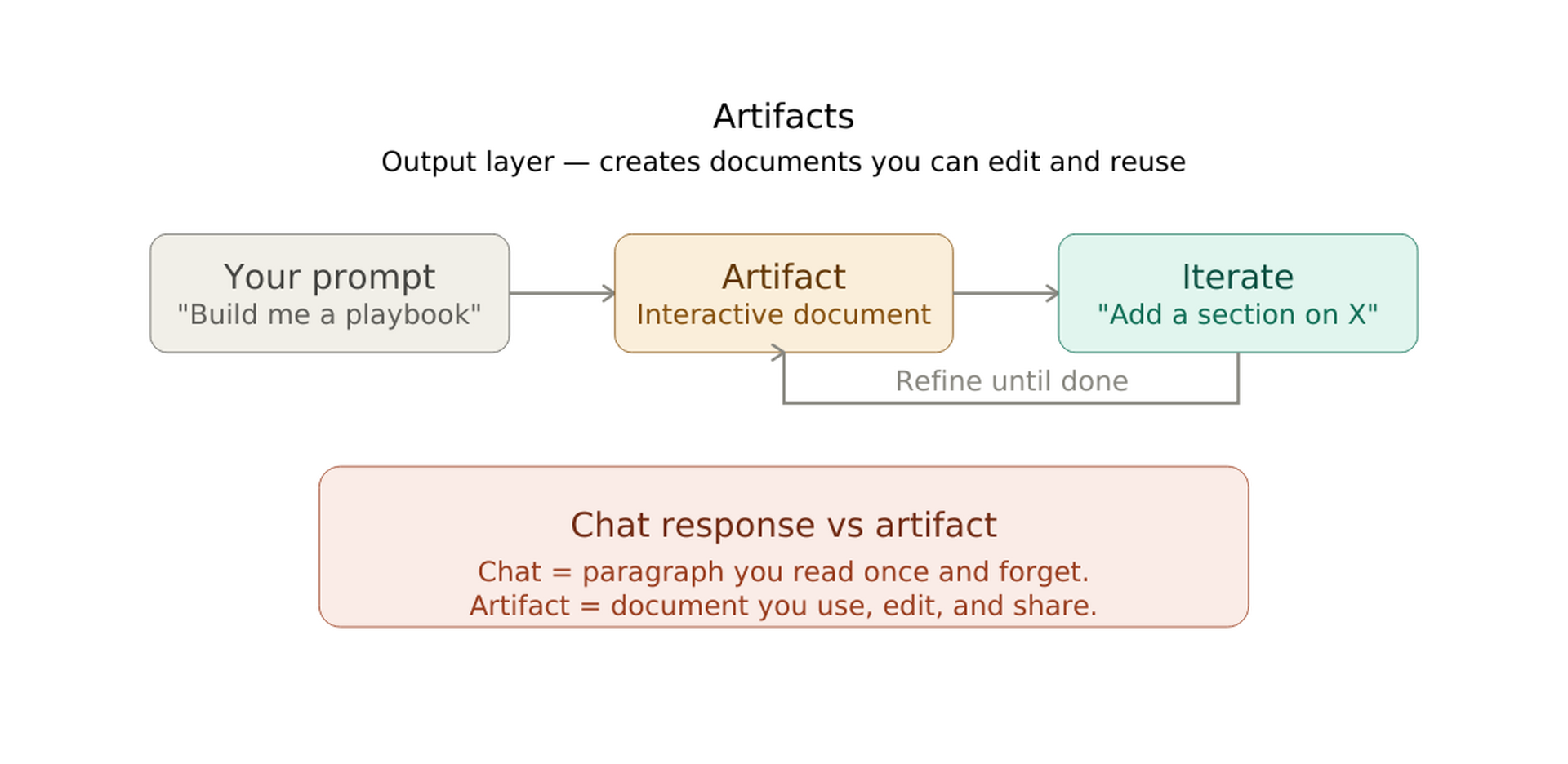
Here's a pattern you've probably experienced: you ask Claude for something, it gives you a wall of text, you read it once, and then it disappears into your chat history.
Artifacts fix that.
When you ask Claude to build something - a playbook, a tracker, a comparison table - it creates an interactive document right there in the interface.
The workflow becomes: ask for a first draft, then say "add a section on objection handling," then "simplify the language," then "make it a one-pager."
Each iteration updates the same artifact. You end up with something you can actually hand to a client or a team member.
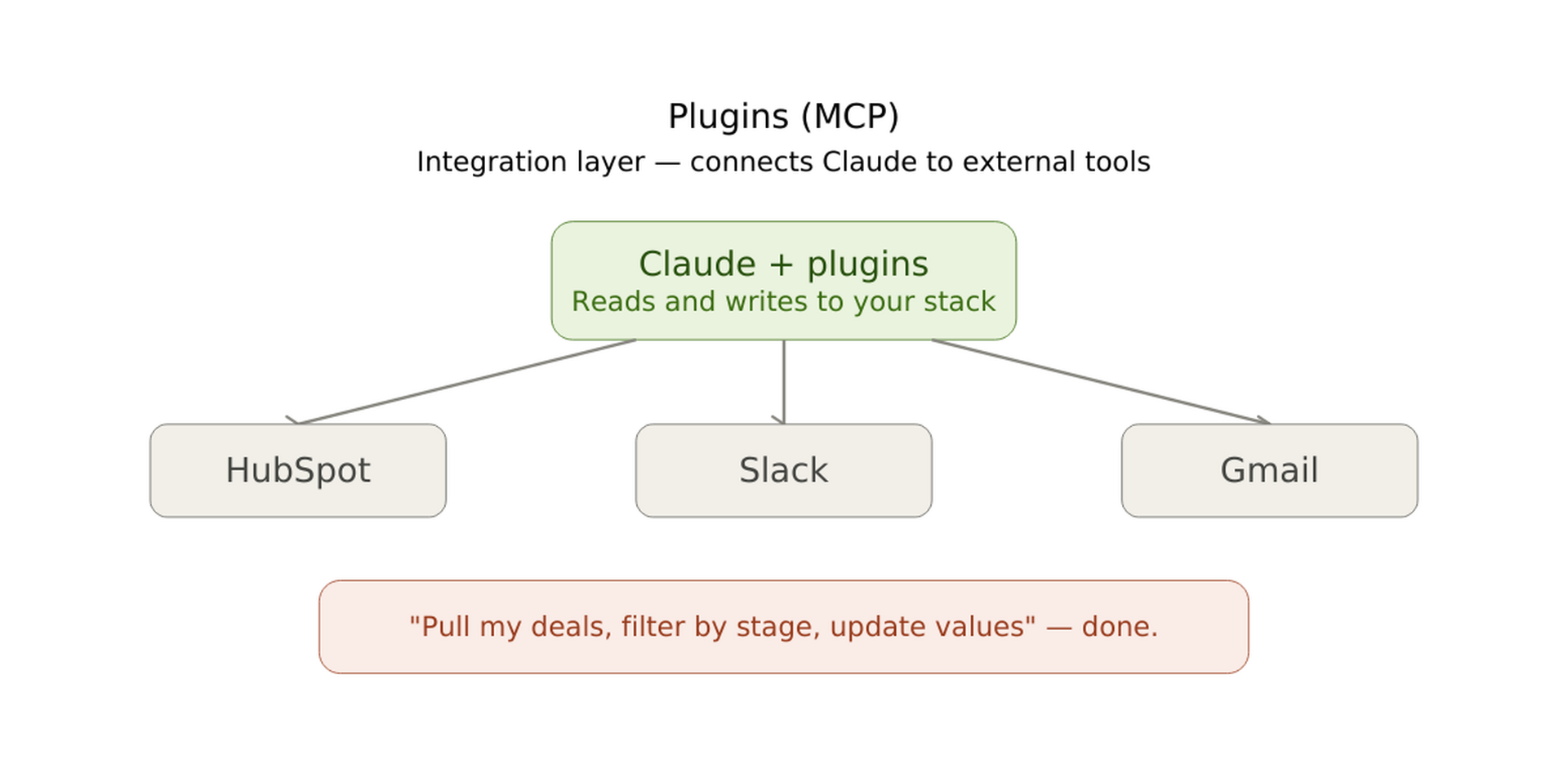
4. Plugins (MCP) - the integration layer.
This is where it gets serious.
Plugins - built on something called MCP (Model Context Protocol) - let Claude connect directly to the tools you already use. HubSpot, Slack, Gmail, Google Calendar, and more.
That means Claude isn't just talking about your data. It's reading it, filtering it, and acting on it.
"Pull my HubSpot deals in negotiation stage, show me which ones haven't been updated in 2 weeks, and update the next step field" - that's one prompt, and Claude does it. Right there in the chat.
5. Skills - the behavior layer.
This is the layer most people don't even know exists. And it might be the most powerful one.
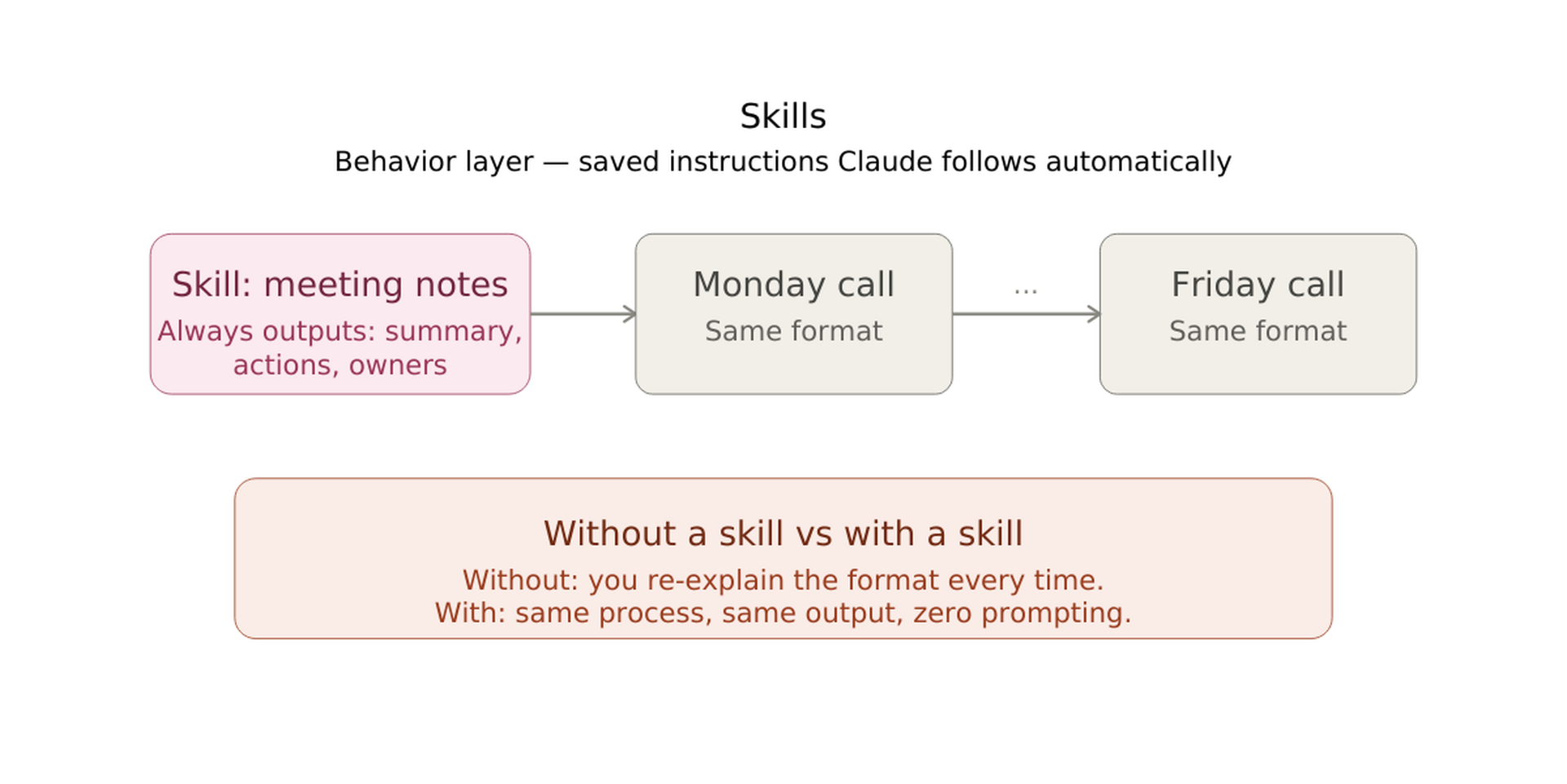
A Skill is a saved set of instructions that tells Claude exactly how to handle a specific task. Not what to know - that's Projects. But how to act.
Think of it like an SOP that Claude follows automatically. I built a Skill for meeting notes: every time I feed it a transcript, it outputs a summary, action items, and owners - same format, every time. No prompting, no reminding, no "actually can you restructure that."
Without a Skill, you re-explain the format every time. With one, same process, same output, zero effort.
The distinction that trips most people up: Projects tell Claude what to know. Skills tell Claude how to behave. You need both.
Where to start
You don't need to set up all five on day one. Start with the layer that solves your biggest friction:
If you're copy-pasting Claude's answers into other tools - try Cowork. If you're re-explaining your business every chat - set up a Project.
If you keep getting text walls instead of usable docs - ask for Artifacts. If you're switching between Claude and your CRM/email - connect a Plugin. If you're repeating the same instructions over and over - build a Skill.
Pick one. Set it up. Watch what changes.
We're still figuring all of this out ourselves, but every week the way we work gets a little sharper.